
Summer has a lot to recommend it. There are more hours of daylight, everything is green. Birds are singing and children are laughing and playing. Even after you’ve grown and the months-long break from school is no longer a factor, Summer can still feel like a reprieve in a lot of ways. Except for one.
It’s July 2nd, 2026 and even your fingernails are sweating. Step outside for one second and you get punched in the face by a heat that feels vindictive. On days like these I confess that I feel a certain amount of ambivalence about this much-beloved season. Still, there are things that make it worth leaving one’s air conditioned cocoon and venturing into a lovely—albeit packed— third floor walk-up studio in hopes of experiencing something special. And that is what happened as around 60 very fortunate people brought their 98.6 degree bodies out on a nearly identical temperature day to commune at Baum Baum Club for Christopher Hoffman and Two of Anything.
Those familiar with Pittsburgh’s Jazz scene have likely at least heard the name Patrick Breiner. Patrick is a marvelous saxophonist and, to borrow a term, ‘woodwinder’ who, once you’ve learned who he is, seems to show up everywhere. He is a force in the local improvisation culture and a fierce music community enthusiast. He is particularly supportive of the work Baum Baum Club and Telegraph Tree are doing and it is our shared values that led the lot of us to collaborating with Patrick, who curated this night of music.
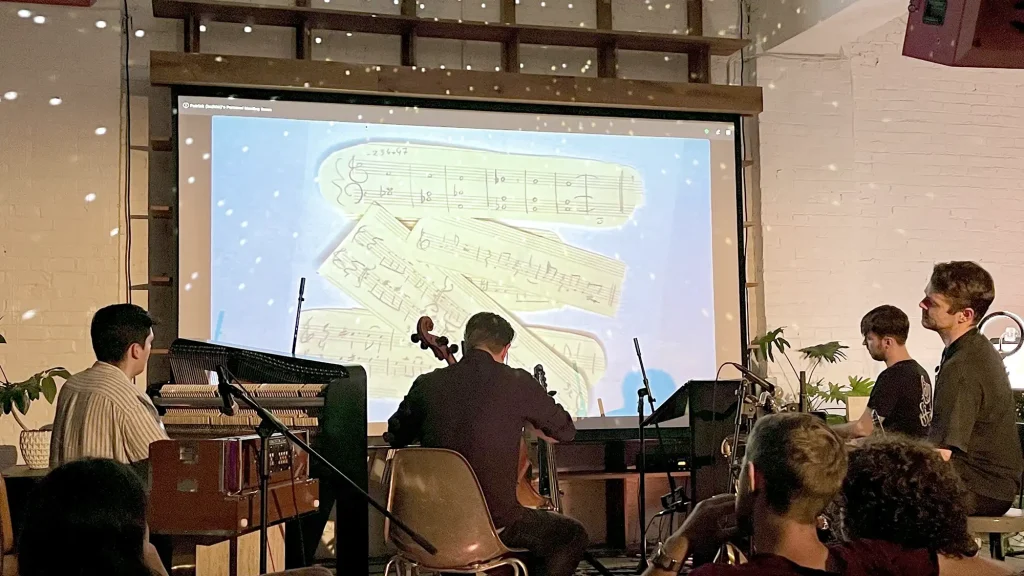
As a gratifying mix of new faces and old friends settled into their seats, summer sun pouring in through the windowed wall that is the front end of the studio space, Two of Anything took the stage. Patrick started with an effusive statement about the significance of live music, community, and the room in which we were gathered. He remarked on how precious-few places like it exist in the world. I think everyone there felt that significance, but having it expressed, especially from the stage, helped complete a kind of circuit that doesn’t always connect in every live music setting. The connection was definitely made and the current began to flow immediately. Two of Anything is Patrick’s brainchild, designed for a trio of himself and two very specific pianists—Mark Micchelli and Antonio Croes. On paper, the concept is relatively simple: Patrick writes out a few bars of music that the musicians are free to interpret live in the moment. Then, quite literally on paper, the dynamism and complexity of the piece comes into focus as scraps upon which Patrick has etched his flexible compositions are selected at random by a few audience members and then projected onto a screen which the players are facing. From that moment forward everything is spontaneous. Pianos (and occasionally a harmonium and an accordion) spring to life and Patrick, who may grab his saxophone or a clarinet as his instincts dictate, are all engaged in a conversation, the likes of which could be chaotic if it weren’t for the exceptional nature of these three musicians (four when they are joined by Christopher Hoffman later in the evening). Each player is free to decide which of the bars they will interpret at any moment and they will react to each other’s interpretations. Then, as the mood strikes him, Patrick will get up and wander into the audience to have new scraps selected which will be added to or replace the current projections and the spontaneous composition evolves and deepens. The effect is profound as everyone in the room is rapt by the singularity of what is happening. And not only the innate newness of it, but the elevation and beauty of it as well. In lesser hands it could have all the unique impact of a car crash, but here it’s much more like seeing a garden grow in rapid succession.
After a brief intermission to re-set and give everyone a chance to stretch their legs, Christopher Hoffman took the stage. I confess I only knew Christopher by name prior to Patrick suggesting him as a possible booking for Baum Baum. Patrick had been studying Jazz at The New School in New York at the same time that Christopher was teaching there and they have kept in touch ever since. The Baum Baum folks and I really trust Patrick’s sensibilities anyway, but it only took a very brief investigation of Christopher’s work to confirm that inviting him to play here was the right move.
Christopher Hoffman is a cellist with a deep musical pedigree. In addition to being a part of Henry Threadgill’s band for the past two decades, he has also worked with Marc Ribot, Yoko Ono, Iron & Wine, and a diverse list of other important figures in popular music. All of that would be more than enough to pique one’s interest, but it’s his solo cello compositions that really set him apart. The crowd sat utterly silent as Christopher unwound one beguiling piece after another, layering his instrument to create narrative musical worlds that, even if he had not taken the between-song time to lovingly explain their inspiration, felt like stories unto themselves. Everyone in the room was transported and time evaporated somewhere between his first and final note.
After as brief a pause as possible, Two of Anything reclaimed their positions on stage, this time joined by Christopher. New papers were chosen and projected and the group, now a quartet, set to work. Despite the format being essentially the same as earlier in the evening, the addition of Christopher and the caliber of everyone in the ensemble gave the performance a freshness and vitality that one might have thought unattainable, given how much had been expressed in their opening set. Strings, keys, and reeds all operating at peak power gave the listeners (including, I imagine, the musicians themselves) a sense of being carried away by a river. No one was exactly in control but neither was there any fear of going under. We were all very much on-board.
After much applause, the delighted attendants gathered themselves. Christopher, assisted by his daughter, greeted people at the merch table. Drinks were finished and hugs were exchanged as the capacity crowd thinned until it was down to just the musicians and hosts. This point in the evening is always quietly mesmerizing to me. Everyone is on the other side of what we set out to do and, in that moment, it never ceases to be surreal to me that we did it. Prior to pulling it off, it can feel like a small mountain of logistics, any aspect of which could upend the whole endeavor but, once things find their place (as they always seem to do), then there is live music and music is a force that transcends any and all hopes or concerns. Those details fade away and something mystical—and much greater than the sum of its parts—is left in their place.